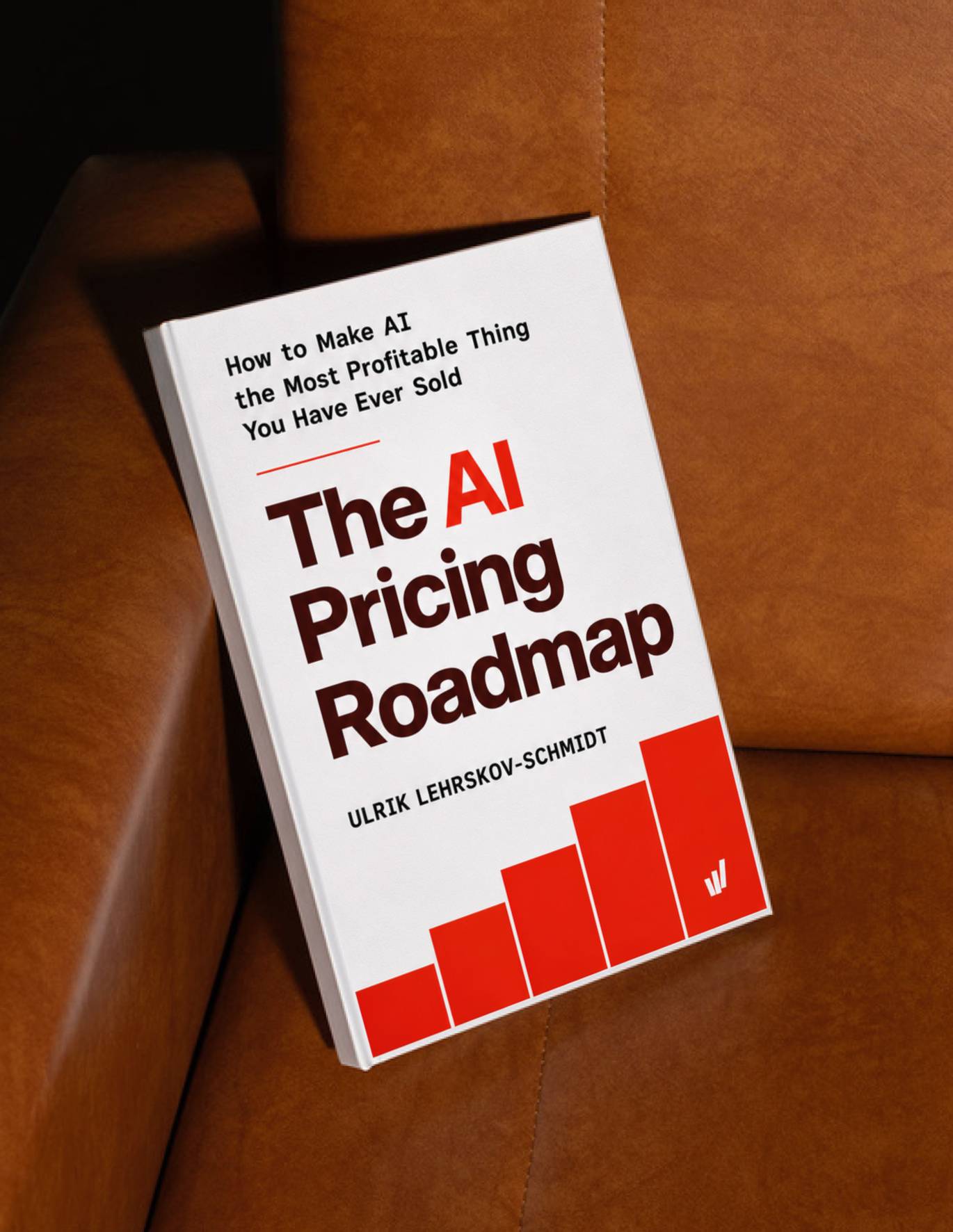













































Why This Book Matters
Traditional SaaS economics are a beautiful thing. You build the product once, you host it, and every additional customer costs you close to nothing. That's how the industry got to 80% gross margins, and it's why nobody had to think hard about cost when they designed a pricing model. Cost was a rounding error. AI ends that.
AI changes the economics. Your pricing has to keep up.
Every query, every API call, every token has a real cost attached, and the more your customers use the feature, the more it costs you to serve them. Price it like you'd price any other feature (flat fee, unlimited usage) and you've built an adverse selection machine: your heaviest users crush your margins, your lightest users subsidize them, and the invoice for that mistake doesn't show up until the margin report does, by which point it's a repricing project, not a pricing tweak. This isn't theoretical. OpenAI reportedly struggled with heavy users on its own top-tier plans. Atlassian tied a 10% price increase directly to rising AI infrastructure cost, in public.
And the ground keeps moving under you while you're trying to fix it. Input token prices fell roughly 97% through 2024, one leading model went from about $5 to $0.15 per million tokens, but as models got cheaper they also got better, so customers started asking harder, more expensive questions. Your unit cost was halving at the same time your compute-per-customer was climbing. I wrote a whole book on pricing a normal SaaS product because that problem holds still long enough to solve once. This one doesn't hold still. The pricing metric that worked in January is often wrong by June.
About the author
Ulrik Lehrskov-Schmidt is a leading global expert on B2B SaaS pricing, and advices tech companies across Europe, US and Asia-Pacific to create pricing models that radically accelerates growth and unlocks the value of their underlying technology.
He has done commercial redesigns for over 100+ B2B SaaS companies, including dozens of business model transformations from perpetual license and on-prem legacy solutions to cloud based SaaS. He has worked for both privately held and publicly listed companies, from early stage venture to $10B+ recurring revenue enterprises.
He is a former entrepreneur with 3x exits, a prolific writer and active keynote speaker on the topics of Pricing & Monetization, Business Models, Market Validation of Products, Commercially Driven Product Design and Behavioural Economics.
He holds a graduate degree in Analytical Philosophy & a Masters degree in Finance from Harvard University.



Rethink how much you charge.