issued on:
May 4, 2026
author:
Ulrik Lehrskov-Schmidt
There’s a tempting idea that because pricing impacts everyone, everyone should be involved in deciding it. In practice, that leads to bad outcomes.
People are naturally focused on their own function, not the company as a whole. Sales optimizes for closing deals, Finance for systems and predictability, Legal for compliance. So when you propose a pricing change - say, moving from “per user” to “per unit of work”- you’ll mostly hear constraints:
- Sales: “Customers won’t understand it.”
- Finance: “Our systems can’t support it.”
- Legal: “We can’t change contracts.”
These are valid concerns, but they’re local optimizations. They highlight risks, not opportunities. If you let every function weigh in equally, you end up with watered-down decisions or no decision at all.
Instead, pricing should be run as a benevolent dictatorship: gather input widely, but keep decision-making centralized. Listen to objections, understand trade-offs, then make a clear call. After that, validate the new pricing internally and with customers before rolling it out.
How to do it:
- Appoint a single decision-maker (“pricing dictator”)
- If you’re below ~$25M ARR: CEO or founder
- Above ~$25M ARR: a C-level exec or senior strategy lead
- This is not your Head of Pricing - they support the process but don’t own the final call
- Form a small working group (2–4 people) across key functions (e.g. Sales, Product)
- Meet frequently, iterate on options, and converge quickly
- The dictator makes the final decision and drives it forward
Pricing works best when it’s informed by many-but decided by one.
As promised, a point about pricing.
One Idea...
What is the Expansion Cube in pricing?
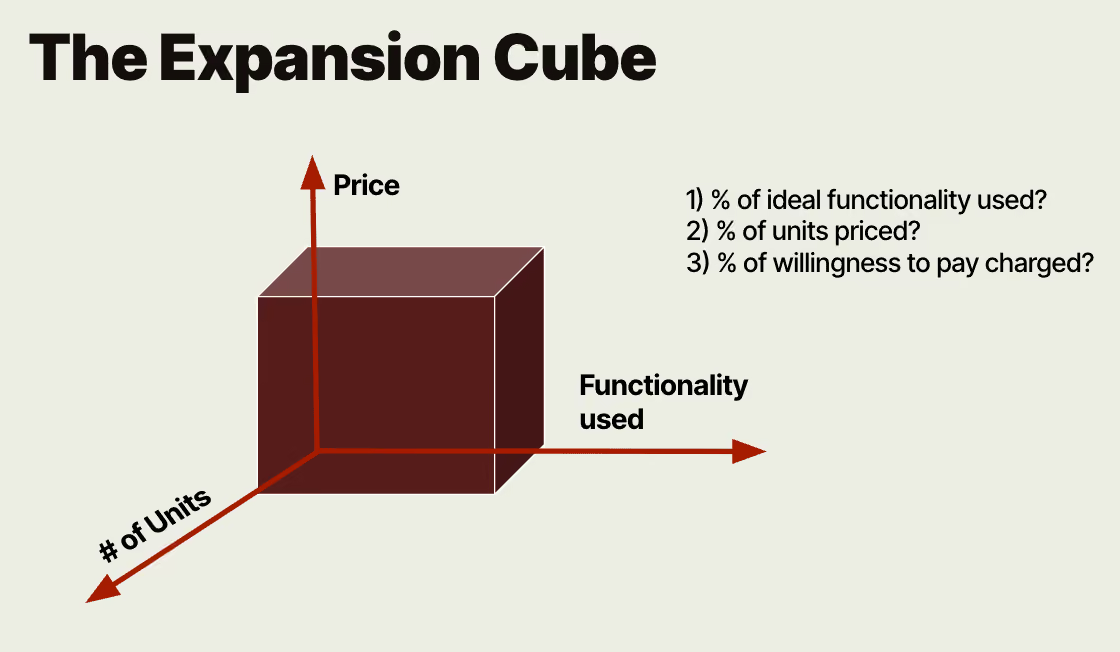
The Expansion Cube is a framework for understanding how revenue from existing customers grows over time. It shows that there are only three fundamental levers to increase revenue - and that they multiply together, creating compounding growth rather than linear growth.
The Three Dimensions
- Product (What they buy)
Customers purchase more functionality - upgrades, add‑ons, higher tiers, or additional modules. - Volume (How much they buy) Customers increase usage - more users, seats, transactions, API calls, storage, etc.
- Price (What they pay per unit) You improve pricing - raise list prices, reduce discounting, or better capture willingness to pay.
These three axes form a conceptual “cube.” When you expand along more than one axis at the same time, revenue grows multiplicatively. For example, increasing product adoption, usage, and price together can dramatically increase customer lifetime value.
Why It Matters
Many companies focus on just one lever (e.g., selling more seats).
The Expansion Cube highlights that real growth happens when you systematically work across all three dimensions.
Because they compound, small improvements in each area can produce outsized revenue expansion.
In Simple Terms:
Revenue from existing customers grows by selling them more product, more volume, or at a higher price - and the strongest expansion happens when you improve all three together.
Willingness To Pay News
Sassiest Conference 4-6th of May

We’re heading to SaaSiest 2026 from May 4th–6th - and we’re bringing pricing to the main stage.
On May 5th at 15:30, Ulrik takes the spotlight with a keynote that cuts through the noise: “How to F*ck Up Your Pricing.”
This isn’t theory. It’s a straight-up, no-BS breakdown of how companies systematically get pricing wrong - packed with real examples that might hit closer to home than you’d like. Because pricing mistakes aren’t just small inefficiencies - they’re silent revenue killers.
And here’s the thing: pricing isn’t something you “fix later.”
It’s one of the most powerful growth levers in your company.
In this session, Ulrik will:
- Break down what’s actually working in AI monetization
- Share best-in-class pricing models
- Roast real pricing setups live
- And most importantly, show you how to fix your own model
Done right, pricing can unlock 10–50% more revenue per customer.
If you’re attending SaaSiest, come find us - and don’t miss the talk.
See you in Malmö.
Our Podcast "Pricing Page unPacked" Just Launched
We’ve just launched the very first episode of Pricing Page Unpacked, and we’re starting with one of the most well-known SaaS pricing pages: Figma.
Figma is often held up as a strong example of product-led growth, but their pricing and packaging choices are just as interesting when you take a closer look.
In this episode, Ulrik and Rob dig into:
- How Figma structures its plans
- How they monetize collaboration
- What their pricing page signals to users
- How their approach has evolved over time
The goal is simple: to understand what these decisions actually mean for the business behind the product.
If you work with SaaS, pricing, or growth, there’s a lot to learn from how a company like Figma communicates value.
If you enjoy it, we’d really appreciate you sharing it with others in the SaaS space.
Spotify | Youtube | Apple | Amazon

Rethink how much you charge.